Book Where You Stream
The live music headlines say demand is cracking. The data says the opposite. The gap between those two stories is where the money is.

If you only read the trades this spring, you'd think live music was in freefall. Tours canceling. Half-empty arenas. The press even gave it a name: "blue dot fever," after the unsold seats lighting up blue on Ticketmaster's maps.
Here's the contrarian read, and Luminate's June 2026 Live Music report backs it: demand didn't leave. The map is wrong.
The numbers that kill the panic
Live music is coming off several record years. Goldman Sachs projects the global live business hits $67.1 billion by 2035. Morgan Stanley sees U.S. live revenue clearing $14 billion by 2028. The top 100 tours were flat in 2025 versus 2024, yes, but they're still up 85.7% in gross and 40.7% in attendance over 2019.
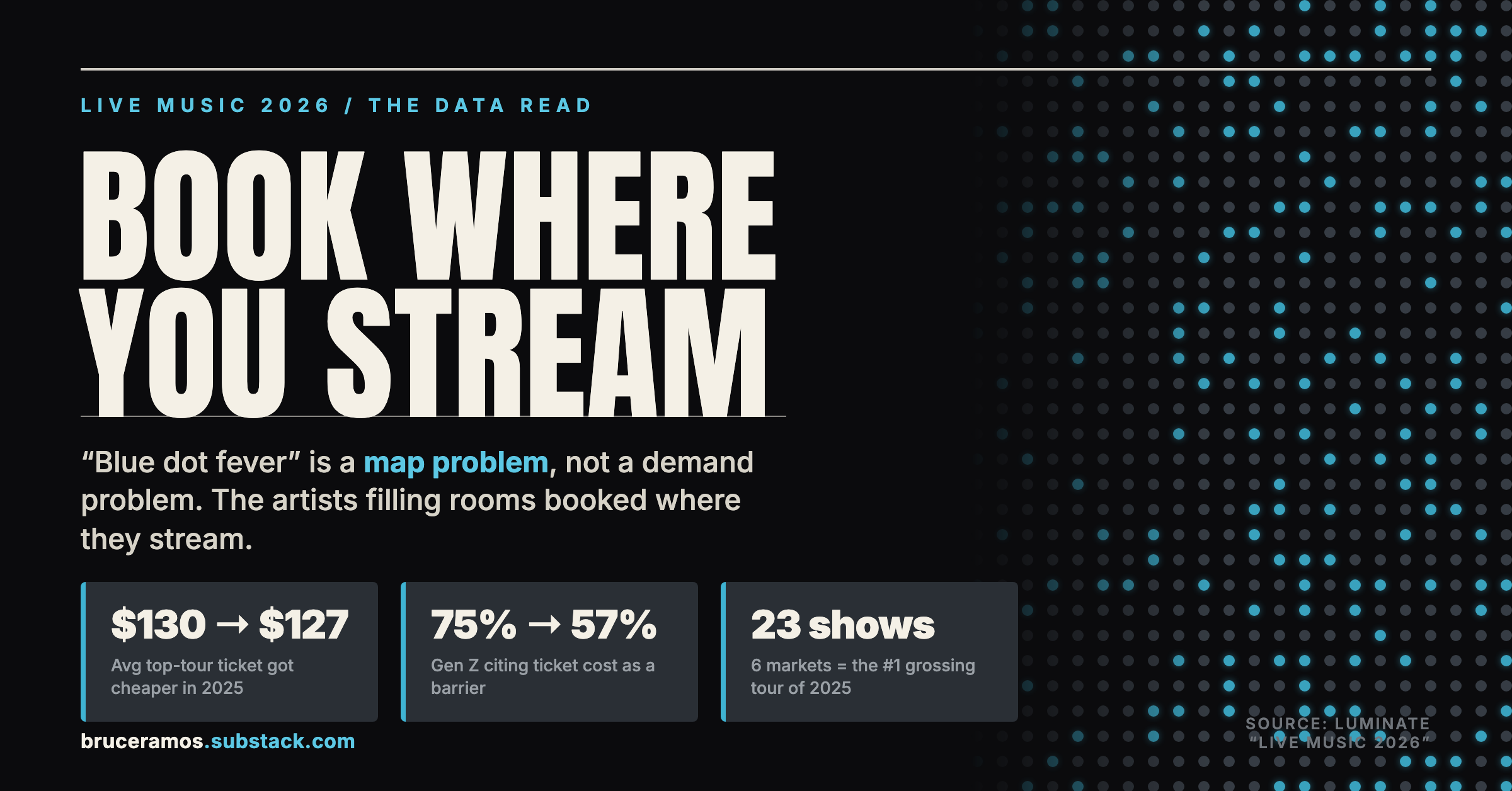
Skip to the part the panic crowd misses. The average top-tour ticket actually got cheaper in 2025, $130.36 down to $127.17. Price sensitivity is falling, not rising, especially with younger fans: the share of Gen Z naming ticket cost as a barrier dropped from 75% in Q1 2024 to 57% in Q1 2026. And perceived value climbed while prices did, with fans calling concerts a good or great value rising from 73% to 78%, festivals from 74% to 82%.
Healthy demand. Healthy willingness to pay. The blue dots are real, but they are not a demand story.
What blue dot fever actually is
It's a geography mismatch, and the winners already solved it.
Look at who topped 2025. Beyoncé's Cowboy Carter was the highest-grossing tour of the year, $306 million from her U.S. dates, off just 23 shows in 6 markets. That was deliberate. She ran a mini-residency, multiple nights in a single city, and made fans travel to her. Tyler, the Creator played 52 U.S. shows, but his hometown of Los Angeles wildly overindexes, because that is where he streams hardest. The Lumineers booked the North and Midwest markets that already overstream them.
The pattern hiding in those charts is simple: the artists who filled rooms booked where they stream. Blue dots show up when you book where you don't.
Festivals tell the same story from the other side. Music Festival Wizard logged 107 cancellations in 2025, up from 89 the year before. European sellout rates slid from 29% in 2022 to 17% in 2025. The events still selling out are the top brands and the tight, genre-specific ones. Coachella's 2026 edition was its first post-pandemic sellout. The middle, the eclectic mid-tier lineup in a market with no heat, is where the seats go blue.
Why this is a Regional Mexican opportunity, not a warning
Bad Bunny is the proof of concept nobody in our lane is fully copying yet. His album DeBÍ TiRAR MáS FOToS plus a San Juan residency helped bring a record 7.5 million visitors to Puerto Rico in 2025. A residency moved a national tourism economy. Gen Z is leading a rise in "music tourism," and the share of Zoomers citing travel cost as a barrier has been dropping since 2024.
Regional Mexican already has the one ingredient this play requires: density. Our fanbases concentrate hard in specific U.S. metros and specific regions of Mexico. We treat that as a ceiling. It's a residency waiting to happen.
The instinct is to sprinkle 30 half-full dates across secondary markets and call it a tour. The data says do the opposite. Plant four nights where the streaming heatmap is red, price the premium tiers for the superfans who will travel, and let the pilgrimage do the work. You can't out-spend the majors on production. You can out-know them on geography.
The second payday nobody books for
There's a payout most teams leave on the table. When My Chemical Romance ran their Black Parade 20th anniversary tour, 10 dates grossing $82.5 million, their streams spiked during the run. Tours generate two paydays: the gate, and the streaming velocity in that market afterward. Most teams count only the ticket gross. You earned both.
For an independent or Regional Mexican artist, that's the real arbitrage. A well-placed residency lights up streaming and catalog value in that exact DMA, on top of ticket gross. If you only measure the night, you walked past half of what you made.
What to do about it
Pull your streaming map before you route the tour. Rank your markets by on-demand streams per capita, not by venue availability. That ranking is your booking order, full stop.
Trade sprawl for depth. Two or three nights in your top markets beats one night across a dozen cold ones. Beyoncé proved it at the top. It scales down.
Price for the superfan, not the median. Superfans are 29% of live attendees versus 19% of the general population, and they spend more on everything. Build premium tiers they will actually travel for.
Measure the streaming dividend. Track on-demand streams in each tour market for 30 days after the show. That number belongs in your tour P&L next to the gate.
Build the room around the fanbase that shows up. Gen Z women are outpacing men in concert intent while Gen Z men drift toward gaming. Know who travels for you before you design the night.
Want the data to do this for Latin specifically? CatalogIQ runs a free Latin market benchmark that shows you where your genre over and underindexes by market: catalogiq.io/benchmark/latin.
The bottom line
Blue dot fever isn't a verdict on live music. It's a verdict on touring blind.
The artists filling seats in 2026 aren't the ones with the biggest names. They're the ones who read the map before they printed the tickets.
The data to do that is already sitting in your streaming dashboard. Open it before you book the next date.
Bruce Ramos is Co-Founder of DSTRO7, a boutique Latin distribution company. 20+ years in music tech, including SVP Digital Monetization at Del Records. This post is part of The Operator's Guide to Latin Music Distribution.
Data source: Luminate Intelligence, "Live Music 2026," June 2026. Additional figures from Goldman Sachs Music in the Air, Morgan Stanley, Billboard Boxscore, Music Festival Wizard, and the Yourope European Festival Report.